
2.1 Structuring Decision-Making as an Algorithm
Human and organizational decision-making can be understood by drawing parallels with IT system architecture.
In an IT system, the Operating System (OS) manages hardware and other resources and provides the foundation on which Applications operate. An Application is a program executed to achieve a particular purpose. Even when the same OS is used, different Applications may be operated depending on the system’s objectives.
However, when the available Infrastructure cannot meet an Application’s resource requirements, the Application may fail to operate correctly. In such a case, restarting the Application may not resolve the underlying problem. Resource limitations or design issues may need to be identified, and the system’s configuration or operation may need to be revised.
OSODT applies this architectural perspective to the decision-making structures of people and organizations.
The body responsible for making decisions is regarded as the OS. The initiatives selected through decision-making are regarded as Applications, while the people and organizations that actually carry out those initiatives constitute the Execution Environment. The resource foundation that supports these activities is defined as Infrastructure.
OSODT therefore examines its subjects through four domains, collectively referred to as the Four Domains.
Infrastructure
Infrastructure is the resource foundation required to operate the OS and its Applications. It includes the physical and institutional foundations necessary to sustain activities, such as facilities, technology, and financial resources.
OS (Decision-Making Center)
The OS is the decision-making body that recognizes the current situation, selects the necessary initiatives, observes their results, and revises decisions or Applications when required. The scope of the OS varies depending on whether the subject of analysis is an individual, a company, a state, or another decision-making body.
Application
An Application is an initiative selected and launched by the OS to achieve its objectives. Examples include business activities and projects in companies, as well as public policies and military operations in states.
Execution Environment
The Execution Environment comprises the people, organizations, and operating conditions through which Applications selected by the OS are carried out in the real world. The capabilities and conditions of the Execution Environment influence whether an Application can be executed and what outcomes it produces.
Relationships Among the Four Domains
The OS selects an Application according to its objectives and carries it out through the Execution Environment. During execution, results and information from the field are observed and returned to the OS. The OS receives this information and, where necessary, revises its decisions or Applications. Infrastructure provides the underlying foundation that supports the activities of the OS, Applications, and Execution Environment.
The important point is that OSODT examines not only the individual condition of each domain but also the relationships connecting them.
For example, even when the OS selects an appropriate Application, the initiative may fail if the available Infrastructure lacks the necessary resources. Likewise, even when sufficient Infrastructure exists, the expected results may not be achieved if the Execution Environment is unable to carry out the initiative.
OSODT therefore structurally analyzes both the conditions of the Four Domains and the relationships among them.
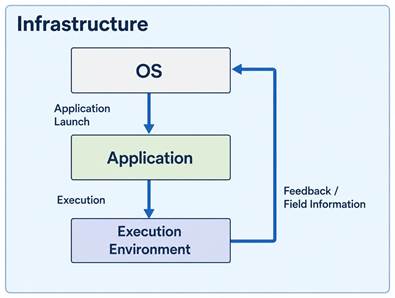
Figure 1: The Four Domains of OSODT
Figure 1 illustrates the relationship in which Infrastructure provides the underlying foundation, the OS launches Applications, and the Execution Environment carries out the selected initiatives. It also shows the feedback relationship through which execution results and information from the field are returned to the OS.
- Date Created: 2026-11-27
- Last Updated: –
- Based on OSODT Version: R1.39.00.00
- Reference Version: R0.01
- Maintained by: Kosmon-Lab
← Back to OSODT Official Reference